[Note: The majority of this content is not my own. I have merely aggregated content from more knowledgeable folks here for my own reference.]
Key takeaways from @cdixon‘s Why Web3 Matters:
- Web1 (~1990-2005) was about open protocols that were decentralised and community-governed. Most of the value accrued to the edges of the network — users and builders.
- Entrepreneurs built on this knowing the protocols were open and they couldn’t be deplatformed. Generally focused on skeuomorphic ideas – i.e. magazines on the internet
- Web2 (~2005-2020) was about siloed, centralized services run by corporations. Most of the value accrued to a handful of companies like Google, Apple, Amazon, and Facebook.
- A few large tech companies built powerful networks as platforms. Users generated content for these platforms however high takerate and lack of ownership disenfranchised creators.
- Web3 (2021+) is about combining the decentralized, community-governed ethos of web1 with the advanced, modern functionality of web2.
- Coders and creators will build on this knowing the protocols are now open again. Value ideally returns to creators with shared value distributed across networks that become economies
- Web3 is the internet owned by the builders and users, orchestrated with tokens. (@packyM)
Key takeaways from Fabric Ventures’ What is Web 3.0 & Why It Matters:
- Web3 is a leap forward to open, trustless and permissionless networks:
- ‘Open’ in that they are built from open source software built by an open and accessible community of developers and executed in full view of the world.
- ‘Trustless’ in that the network itself allows participants to interact publicly or privately without a trusted third party.
- ‘Permissionless’ in that anyone, both users and suppliers, an participate without authorisation from a governing body.
- Web 3.0 enables a future where distributed users and machines are able to interact with data, value and other counterparties via a substrate of peer-to-peer networks without the need for third parties. The result: a composable human-centric & privacy preserving computing fabric for the next wave of the web.
- With Web 3.0, women, men, machines & businesses will be able to trade value, information & work with global counterparties they don’t know or yet explicitly trust, without an intermediary. The most important evolution enabled by Web3.0 is the minimisation of the trust required for coordination on a global scale. This marks a move towards trusting all constituents of a network implicitly rather than needing to trust each individual explicitly and/or seeking to achieve trust extrinsically.
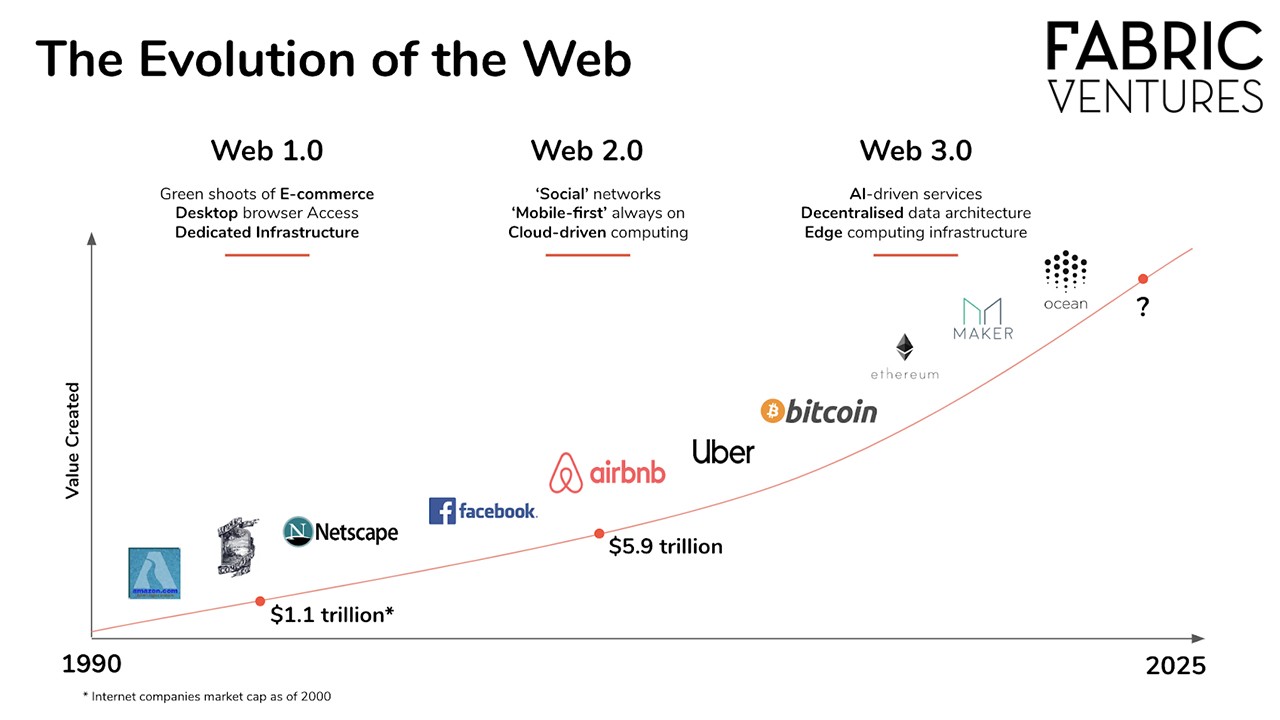
Source: Fabric Ventures
 Div Prakash